New technologies inspire children to be creative, communicate and learn. However, while the internet is a great resource, it is important that children and young people are protected from the risks they may encounter. The UK Council for Child Internet Safety (UKCCIS) is a group of more than 200 organisations drawn from across government, industry, law, academia and charity sectors that work in partnership to help keep children safe online. The Council was established in 2008 following a review by Professor Tanya Byron discussing, and taking action, on topical issues concerning children’s use of the internet. Latest news Click Here
This consultation seeks views on the government’s Internet Safety Strategy.
This consultation closes at midday on 7 December 2017
Consultation description
The Internet Safety Strategy looks at how we can ensure Britain is the safest place in the world to be online. The Strategy considers the responsibilities of companies to their users, the use of technical solutions to prevent online harms and government’s role in supporting users.
The consultation covers various aspects of online safety including:
the introduction of a social media code of practice, transparency reporting and a social media levy,
technological solutions to online harms,
developing children’s digital literacy,
support for parents and carers,
adults’ experience of online abuse, and
young people’s use of online dating websites/ applications.
Also published today: Children’s online activities, risks and safety: A literature review by the UKCCIS Evidence Group. To be found on the UKCCIS webpage
If you would like to review a list of the consultation questions before completing the online survey, please contact us at the email address below.
Today Snapchat introduced a new feature, the ‘Snap Map’.
This location based map allows users to see where in the country their Snapchat contacts are, as well as seeing location based photos and videos. The Snap Map shows a user’s Bitmoji, their cartoon avatar within Snapchat, pinpointed on a world map. Users can then zoom into the map to see the exact location of their friends.
How to access Snap Maps
To access the Snap Map in the latest update of the Snapchat app, users need to go to their camera screen within Snapchat and zoom out using two fingers. This will then launch the Snap Maps screen and will allow a user to see their friend’s locations.
Choose who can see your location
It is important to be careful about who you share your location with, as it can allow people to build up a picture of where you live, go to school and spend your time.
Given how specific this new feature is on Snapchat - giving your location to a precise pinpoint on a map - we would encourage users not to share their location, especially with people they don’t know in person.
There are three settings for sharing your location on the map, these are; Ghost mode, My Friends, and Select Friends. But what do these settings mean?
Ghost Mode Ghost Mode means that you are the only person who can see your location on the map. Within Ghost Mode you can still see the locations of your friends but they will be unable to see you. This setting will ensure that you have complete control over who knows your location.
My Friends My Friends means that all of your contacts on Snapchat can see your location. If turning on this setting then it would be important for users to review their Snapchat contacts and also make sure that they never add someone they don’t know in person onto Snapchat.
Select Friends This setting allows users to look through their friend list and then decide which of their friends they want to be able to view their location. This setting gives users the opportunity to control who can view their location.
Changing settings
When first opening the Snap Map users get to make a decision of who they want to be able to view their location. Once these settings are in place they can always be changed in Snapchat’s settings. This can be done in two ways:
In the Snapchat settings In the Snapchat screen click on the Settings (cog) icon> click on ‘see my location’ > Choose the setting which suits you
On the Snap Map Click on the setting button in the top right of the map > choose the setting which suits you
Our top tips
Sharing location can be a risky thing to do. Our tips for location sharing are:
Only share your location with people you know in person. Never share your location with strangers.
Don’t add contacts to Snapchat if you don’t know them in person.
Regularly review your settings and take an active decision about whether you want people to know your location. Remember you can switch this off at any time. Think about where you’re sharing your location. Location services such as Snap Maps can lead people to your house. Think about what times you’re on the app and whether these are locations you want to share – if not, then turn this off within your settings.
Thousands of pupils across England, Northern Ireland and Wales have started their GCSE exams, marking the beginning of what can often be a stressful and anxious time for teenagers and parents alike.
From preparing their favourite dinners, to managing expectations (yours and theirs), experts offer their tips on what parents can do to help in the coming weeks.
1. Brain food
Image copyright
Stress, anxiety and late-night cramming can all affect appetite, but parents can help to ensure children maintain a well-balanced diet and aren't missing meals.
Exams generally start at either 09:00 or 13:30 - allowing plenty of time for breakfast and lunch.
Nutritional therapist Kerry Torrens recommends making breakfast the most important meal of the day, filling up on energy-giving oats and eggs, which contain a nutrient called choline - thought to help cognitive performance and improve memory as we age.
As for revision snacks, consultant Dr Alex Richardson recommends popcorn over crisps as it is higher in fibre, so releases energy more slowly, and is lower in calories.
Make sure your child is well hydrated, as mild dehydration can lead to tiredness, headaches and diminished concentration.
The European Food Safety Authority recommends eight to 10 glasses a day, but sparkling water still counts, and can be made less boring by adding lemon, lime, cucumber or mint.
Research has suggested students who take water into the exam hall may even improve their grades.
2. Bedtime
Image copyrightAGES
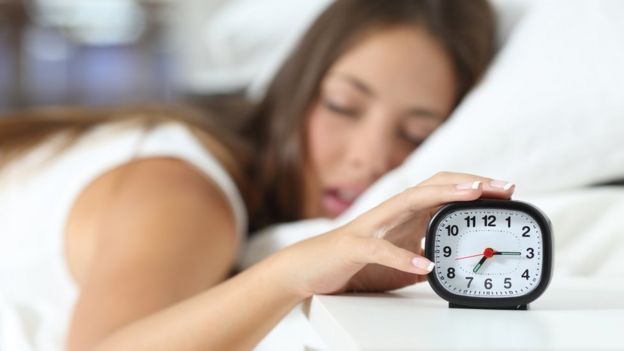
It won't come as a surprise to parents that teenagers need (and like) a lot of sleep. In fact, they need eight to nine hours a night.
But exam season can see priorities change.
Lisa Artis from the Sleep Council argues a good night's sleep is more beneficial than doing last-minute revision into the early hours.
"When you sleep well, you function and perform better and your memory is better, meaning you retain what you have revised," she said.
For those too nervous to sleep, Lisa says the hour before bed time is crucial.
"Have a good routine before bed. Relaxing properly will help sleep when you're stressed or anxious. Avoid screen time - including television - and get off social media."
Lisa suggests worried students should write down their anxieties, which can "free your mind of them".
"Parents can encourage children to study out of their bedrooms," she added. "If they are sat on their bed cramming, it becomes a place associated with stress."
If another room is not an option, Lisa suggested "zoning" - creating a desk or work area that is not their bed.
3. Support Vs Pressure
Image copyrightS
Parenting coach Anita Cleare says it's important to "find ways of being supportive without being imposing".
"They know the exams are important. Us ramping up the pressure is not going to help," she said.
While some parents may opt for large rewards, pending results, Anita suggested smaller rewards throughout the process.
"These can be little things like a takeaway or a trip to the cinema after a certain number of hours of revision."
Clinical psychologist Dr Rachel Andrew has been advising a lot of concerned parents in recent months.
"I tell them to look after their teenagers almost as if you would a younger child. You have got to nurture them through this time," she says.
This can be anything from preparing their favourite dinners to offering to run them a bath.
"Give them permission to take a break from revision in between working hard."
Dr Andrew suggests writing a weekly revision timetable, with scheduled gaps for socialising or exercise.
"A moderate level of anxiety will help us perform, but beyond that, we start to be impaired by it."
4. Positive parenting
Image copyrightMAGES
Anita - who is also founder of the Positive Parenting Project - favours an optimistic approach during exam time.
"A failed exam is not the end of the world. It is important to put things in perspective," she says.
Anita - who has a son completing GCSEs this year - admitted parents are often more anxious than their children.
"We can't make anybody learn, you can only provide the conditions that are conducive to it."
Not all exams go well and telling your child "I'm sure it went better than you thought", isn't always helpful according to Dr Andrew.
She said it is important to validate the way they are feeling and talk through it after an exam, before helping them to move on and focus their energy on the next exam.
"Every child is different and will respond differently to pressure," she adds.
Microsoft made a big splash last week when it announced a new education-oriented operating system, Windows 10 S, and debuted a brand new Surface Laptop, but a new study says Microsoft will need a lot of extra credit to catch up to the top tech company in schools, Google.
The study by EdWeek illustrates how far ahead Google is of its tech contemporaries. Google’s low-cost Chromebooks are by far the most popular school-provided device, with 42 percent of educators and administrators saying they use them often. The next closest number is 15 percent for PC laptops.
(EdWeek Chart)
And it’s not just hardware. Google for Education, and its G Suite, which includes programs like Gmail, Hangouts, Drive and more, are the most frequently used set of productivity tools in 68 percent of U.S. classrooms. Microsoft productivity tools are the top choice in 17 percent of classrooms, and Apple tools are popular in only 1 percent of classrooms.
So why Google? Its products are easy to use, educators and administrators say, and affordable.
“It is compatible with other educational sites and easy for students to access at home,” a Houston-area teacher surveyed by EdWeek wrote. “Many children don’t have computers, and Google makes it easy to do assignments from their phones.”
Beyond products, educators and administrators have the most faith in Google’s ability to help students learn. In response to a hypothetical question where educators were allowed to hire one company to increase student achievement, Google was far and away the top choice at 52 percent. Apple Education was the second most common choice at 13 percent. Microsoft came in sixth out of eight companies at 6 percent. Amazon was only favored by 1 percent of educators.
(EdWeek Chart)
Educators don’t see Google losing its lead any time soon. EdWeek asked school administrators, including superintendents and chief financial officers, about future school district spending on various devices over the next couple years, and 90 percent said their schools would increase investments in Chromebooks. For reference, the next most popular device by this metric was the iPad, with 33 percent predicting increased investment.
Microsoft Surface devices and PC laptops got lukewarm receptions in terms of future investments. About 29 percent of educators predicted greater spending on PC laptops with 26 percent seeing more Surface devices coming to classrooms. On the flipside, 22 percent and 19 percent of educators predict a decline in spending on PC laptops and Surfaces, respectively.
As Microsoft and Google battle it out, Amazon is quickly becoming a major player in the education technology scene, according to an analysis of the study by EdWeek Senior Editor Sean Cavanaugh. Many schools use Amazon Web Services for cloud storage, and the online retail giant has a marketplace customized for education. Amazon is also testing a service called Amazon Inspire, which is focused on “the search, discovery, and sharing of digital educational resources.”
With the exam season approaching and revision under way, university researchers have suggested that the smell of rosemary could enhance memory.
A study found that pupils working in a room with the aroma of rosemary, in the form of an essential oil, achieved 5% to 7% better results in memory tests.
Mark Moss from Northumbria University said the findings were consistent with tests on adults.
Dr Moss said the study supported traditional beliefs about rosemary.
He said that rosemary had been associated with memory for hundreds of years.
Ancient Greek students wore garlands of rosemary in exams - and Ophelia, in Shakespeare's play Hamlet, says: "There's rosemary, that's for remembrance."
Herb power
The study, to be presented this week at the annual conference of the British Psychological Society, will back the "received wisdom" that rosemary can assist memory.
In the tests carried out by Dr Moss and Victoria Earle, 40 pupils aged 10 and 11 carried out a series of memory tests in rooms with and without the aroma of rosemary.
The pupils did not know that they were taking part in memory tests related to scent - but Dr Moss said that those exposed to rosemary had on average an improvement of 5% to 7% in results.
This small-scale test followed up earlier research on adults which had suggested a link between rosemary and memory.
Dr Moss said it confirmed that children as well as adults seemed to be influenced.
But he said there was variability in the level of impact and some people did not seem to respond at all.
'Electrical activity'
He said the human sense of smell is highly sensitive and sends messages to the brain, setting off reactions and responses.
There are neurotransmitters in the brain associated with memory and Dr Moss suggests that these can be affected by scents.
He described it as "almost like a drug interaction" where the brain is influenced by what is being inhaled.
"It could be that aromas affect electrical activity in the brain or that pharmacologically active compounds can be absorbed when adults are exposed," he said.
Dr Moss said the next step should be to extend the study, with "large-scale trials of aroma application in education settings".